"For a subject worked and reworked so often in novels, motion pictures, and television, American Indians remain probably the least understood and most misunderstood Americans of us all."

-John F. Kennedy in
the introduction to The American Heritage Book of Indians

Tuesday, June 28, 2011

Indian Voices: Listening to Native Americans Book Review

I recently reviewed the new book Indian Voices: Listening to Native Americans by Alison Owings.

Read my review from the Bismarck Tribune below:


Native Americans tell their stories in book

Title: “Indian Voices: Listening to Native Americans”
Author: Alison Owings

While driving along an unremarkable two-lane country road, Alison Owings passed a simple road sign that caused her to stop. It read “You are Entering the Navajo Nation.”

As a best-selling author from New Jersey, Owings thought she knew America, but her short jaunt through rural Arizona made her realize just how much she did not.

Shocked and compelled by her own ignorance about Indian Country, Owings set out to write the book her exhaustive library search proved did not yet exist.

“Indian Voices: Listening to Native Americans” unfolds as a series of chapter length interviews with tribal members from across the United States. In these candid discussions, Native Americans of all backgrounds reflect on what it means to be Native in America today.

From the Passamaquoddy blueberry harvester to the Yup'ik educator to the Lakota woman's activist, Owings travels far and wide to converse with her subjects. Stories of hardship and survival, humor and celebration, tradition and modernity are told by the likes of an incarcerated Yurok artist, female Osage lawyer, and Lakota/Navajo urban activist.

Even the most hot-button issues are not off limits; Indian mascots, repatriation of remains, tribal corruption, and spousal abuse all make appearances.

Owings' writing can be summed up in one word: enthralling.

Her vivid prose and penchant for lengthy block quotes bring the scenes and stories to life in vivid detail.

“Indian Voices” has the feel of a documentary film with the camera fixed squarely on the subject.

Owings' musings as the wide-eyed outsider, however, can awkwardly break up the narrative. Indeed, at one point, I found myself wondering if a better subtitle for the book would have been “Listening to Alison Owings Listen to Native Americans.”

Overall though, Owings succeeds in recreating the sense of intimacy she herself must have felt during these long interviews.

The best part about “Indian Voices” is the sheer range of thoughts, feelings and opinions elicited from her subjects; a true reflection of Native America if there ever was one. Even among families, differences exist.

Take the case of Emma George, Lemhi Shoshone and closest known blood-relative of famed Lewis and Clark guide Sakakawea. Emma was always reluctant to acknowledge her famous kin unlike her two sisters who enthusiastically took part in bicentennial activities.

While this book only scratches the surface of America's varied Indigenous communities, it is a welcome addition to the very scant literature on Indian people today.

In addition, while her writing is clearly aimed at a non-Native audience, I feel “Indian Voices” would be a compelling read for both Native and non-Native readers alike. Universal themes of pain, hope, and humor abound.

Having now heard so many truly unique and original voices, I can honestly say I will never look at Native people and culture the same way again. Such is the power of giving one community the opportunity to speak so candidly with the world.


For readers of Drawing on Indians, Owings' subjects make numerous references to challenging Native stereotypes and confronting America's often awkward relationship with Native America.

These individuals provide just the perspective most people lack when dealing with issues of Native cultural appropriation- the Native perspective!

Look!  Smiling and laughing Indians!


You can read some excerpts from the book on Indian Country Today:

http://indiancountrytodaymedianetwork.com/2011/04/indian-voices-loud-and-proud/


<>

Saturday, June 18, 2011

Going Native in Ireland Part II

It's one thing to find a single product in a store that appropriates Native culture but to find an entire business...

Meet Apache Pizza!


Ireland's most popular Native American themed dine-in and carry-out pizza restaurant!

This popular pizza chain with over 40 locations throughout Ireland left me scratching my head just like the Irish Indian Chief Headdress.

Some of the menu highlights include:

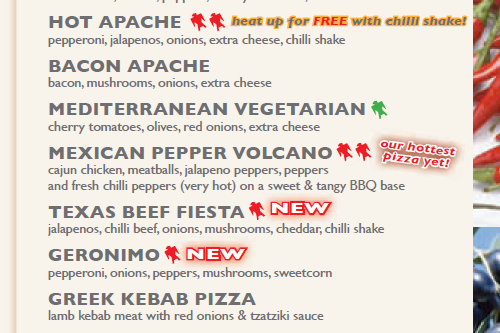
  • WIGWAMMER pizza  (cause nothing screams woodlands tribes like double decker pepperoni!)
  • CAJUN APACHE pizza (I've never had shrimp gumbo with fry bread, have you?)
  • HIAWATHA pizza (which apparently is how they spell Hawaiian in Ireland)
  • BACON APACHE pizza (cause everything is better with bacon?)
  • GERONIMO pizza (how timely of them)

Here is the full menu and a few screenshots:


    And what themed restaurant is complete without over-the-top decoration (click on the images to enlarge)


    (but mankind really had to pee and couldn't afford a slice!)


    And if you can't make it to the restaurant, just order carryout!

    PIZZA BOX (front)

    PIZZA BOX (back) featuring:
    TEN NATIVE AMERICAN COMMANDMENTS


    They even sell licensed merchandise and other novelty gifts such as the Apache Novelty Arrow, Apache Fun Feathers, and Apache Feather Headdress.

    "King of your tribe?, then prove it with a feather headress."


    Someone care to explain to me what Native Americans and the Apache in particular have to do with pizza?

    What's that, absolutely nothing.

    Indeed, Native American culture is a pretty odd choice for a pizza chain in the emerald isle, but then again considering the cultural phenomenon that is the "Indian" I'm sadly not surprised by this.

    This chain is the epitome of "drawing on Indians" because it is so completely detached from real Native culture and instead dives head first into the stereotypical soup of the "Indian".

    It has all the best known elements: a chief head with war bonnet, Hiawatha, Geronimo, a special Indian connection to the natural and spiritual world (though I personally prefer my Native wisdom from tribal elders, not from the back of pizza boxes).


    I'm assuming the founders of Apache Pizza were enchanted with the stereotypical Indian of American frontier lore and decided it would make a great memorable pizza mascot.  Thus was born "Big Chief" (he's named in one of the radio adverts) and Apache Pizza!

    I was originally going to "go easy" on this company and simply decry it for its clear stereotypes of Native Americans but then I heard the radio adverts.

     Apache- Wife

    Apache Pizza is officially racist.  How else can you describe such an ugly stereotype as the tonto-speaking gruff-voiced Indian named Big Chief who literally says HOW every other word?!!!

    Stuff like this is supposed to be a thing of the past but I suppose when you take centuries of ugly stereotypes and then move across the ocean to a place far removed from real Native people, this stuff does happen.  Sad.


    Outraged?

    Let em know:

    http://www.apache.ie/customer_feedback.htm


    For more European examples check out:

    Glastonbury "Indians"

    The Dudesons: A Retrospective

    Going Native in Ireland Part I


    <>

    Tuesday, May 31, 2011

    Going Native in Ireland Part I

    I recently spent some time in Western Europe backpacking through several countries including that beautiful green emerald isle of the north known as Ireland.

    If you have never been to Western Europe, and Ireland in particular, you must first understand that many of these places thrive on tourism.  Huge segments of the Irish, Spanish, French, and Italian economies depend on the billions of tourist dollars brought in every year.

    And what vacation is complete without a few souvenirs!


    Carroll's Irish Gift Stores is a huge chain of souvenir shops strung out along the main tourist thoroughfares in downtown Dublin.  They sell everything from Leprechaun key chains to Guinness slippers to "Kiss me, I'm Irish!" T-shirts.  If it can be made green, white, and orange, it will be sold at Carroll's.

    I thought I had seen it all when my eyes fell upon the most mind-boggling souvenir imaginable!


    The Irish Indian Chief Head Dress

    "Everyone's an Indian on St. Patrick's Day!"


    Oh, and if you can't make it to Ireland anytime soon, you can just pick one up online!


    I suppose this is no worse than the typical Indian costumes you see around Halloween but when you take it out of the context of Halloween, it seems even weirder!  And when you consider that donning this headdress means you are appropriating one culture to celebrate another, that just blows my mind!

    So does this finally prove that the Indian Headdress/War Bonnet has moved beyond mere Indian dress up and instead is a broader fad?  Do people don the Irish “Indian Chief Hat” not to become an Indian but rather show Irish pride in a unique and “fashionable” way?

    Others may say yes, but I say no. You can never fully divulge the associations with American Indians. The thing is clearly supposed to be a send-up of Plains Indian War Bonnets.  (Look at the name!)

    Decades of western media stereotypes have taught Americans and Irishmen alike that the headdress wearing Plains Indian is the ultimate Indian.  To wear any other Native head covering would simply be second rate!  Even when rooting on Irish teams, people want that universally recognized "fierce" look of the Plains warrior with headdress and war paint.

    So who exactly would ever buy the headdress and why?  My money goes on those young hipster types such as the Glastonbury “Indians.”  The types who sport nostalgic clothing in an effort to look hip/ironic but instead look like they're stuck in some multi-dimensional multi-cultural time warp.

    Just check out the grinning fools on the packaging!


    ...cause it just wouldn't be complete without side pieces.


    In the end, this is just another fine example of drawing on Indians.  And if you think this Irish Headdress is silly, just wait till Part II!


    For more info, check out these earlier posts:

    Tribal Chic: Native Appropriation Appropriation?

    Hipster Indians

    <>

    Friday, May 27, 2011

    The Case of the Missing Indian Reservations

    Quick! Somebody call Nancy Drew and the Hardy Boys because we have a mystery on our hands.

    Sometime between the first week of February and the last week of May, American Indian reservations disappeared from Google Maps!

    Back in February 2011, I wrote a blog post titled Strange Tan Blotches in South Dakota: Indian Reservations in Online Maps about the unique look of Indian reservations in Google Maps.

    They were featured on the maps as gray geometric shapes without any labeling whatsoever to identify them as reservations. The uninformed user could easily mistake them for military bases, oil fields, National Parks, or any other large features.

    Notice in the screenshot below the off-color areas in the Dakotas, Montana, Arizona, and other states. Those gray blotches circled in red are Indian reservations as they used to appear in Google Maps.

    Original Image Source: AppAppeal.com


    Now use the Google Maps tool below to scroll around America and try and find those same gray areas.


    They are gone!

    It was bad enough that these reservations were unlabeled in the first instance but to drop them altogether from Google Maps takes it to a whole new level. Someone, somewhere at Google Inc. had to make the decision to remove the reservations. I can only wonder about their reasoning- relevancy, visual clarity, just too much clutter?

    I understand Google Maps prefers brevity and a nice visual aesthetic over volumes of information but the removal of Indian reservations from its mapping service is more important than you think. Consider how many millions of Americans use Google Maps to find directions, locate a business, plan a vacation, or just browse American geography!

    Now, a simple decision at the corporate headquarters will forever affect how millions of Americans understand (or don't understand) the geographic and social reality of this country.

    UPDATE: Indian Reservations are back in Google Maps... but for how long?


    <>

    Wednesday, May 25, 2011

    Hiram Schmetzls Monetary Adventures

    Have you heard about this new summer camp

    Hiram Schmetzls Monetary Adventures

    Set in Vermont's National Forest, your kids will walk past acres of valuable timber property before arriving at our authentic shtetl. They go through a Jewish naming ceremony where they receive a Jewish name which reflects who they are as a unique individual.

    “The naming ceremony was just the most magical thing,” notes camper Timmy. “I heard this weird chanting from behind me when all of a sudden a white shawl was thrown over my shoulders as I was lifted into the air still sitting in my chair! Everyone was chanting 'Levi! Levi!.'

    The boys choose the activities for the day which range from investment strategy to stock market analysis. The campers will also be regaled with stories of famous rabbis and the triumphs of the Jewish people.

    Camp director Stephen Bridenstine notes "No, I'm not Jewish.  I just have the utmost respect for the Jewish people and culture and how they connect on a deeper level with financial issues."

    Offended?  Well, consider just how crazy this camp sounds and let me introduce you to

    Night Eagle Wilderness Adventures


    Tipis!  Indian Naming ceremonies!  Mastering the atlatl and sewing moccasins!  Experiencing the power of Tunkashila or 'Grandfather Rock'!

    What more could boys ages 10-14 want?


    In case you still want to send your kids there, here is the website: http://www.nighteaglewilderness.com/NEWAPages/intro.html

    Thanks to Nicole by way of Debbie Reese at the American Indians in Children's Literature blog for the original piece which you all must read!


    http://americanindiansinchildrensliterature.blogspot.com/2011/04/are-your-kids-going-to-summer-camp.html

    <>